AI spend ownership
Who Owns This AI Spend?
Connect estimated AI consumption to workload identity, approved routes, projected pipeline economics, and runtime limits that give an owner something concrete to manage.
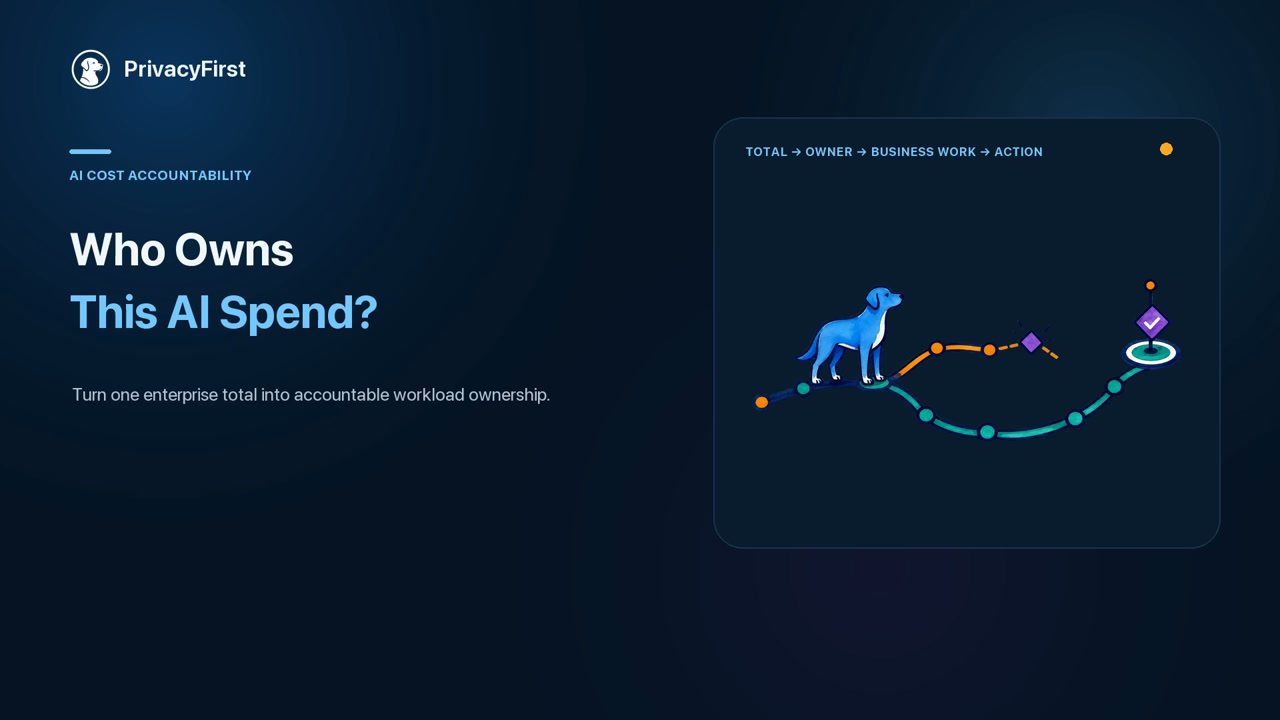
What this answers
- Which application, workspace, route, and provider drove consumption?
- How can teams inspect projected pipeline economics before expansion?
- Where do runtime limits and ownership records meet?
Transcript
Thirty thousand dollars of A.I. spend is a total. It is not an operating answer. Platform teams need to know which production workload created the demand, what path that workload can use, and which limits will stop an expensive surprise before it reaches the invoice. PrivacyFirst starts with one explicit period. Meridian's thirty-day view brings eighty-seven thousand requests, billions of tokens, more than thirty-one thousand dollars of estimated cost, latency, and policy outcomes into one operating surface. This is sustained production demand, not the misleading economics of a single test call. The total stays attached to its operating context. Source and application filters, the selected period, request volume, tokens, error rate, and latency share the same boundary. The cost is explicitly labeled as an estimate, while the raw-logging warning remains visible. Operators can make a cost decision without losing the reliability or data-handling conditions around that traffic. Ownership begins with workload identity. Meridian separates its operations copilot, batch claims, clinician notes, and patient triage behind named access keys. Each key is bound to its own routing pool and processing choice. That makes the accountable unit a production workload, not a shared secret called A.I. production. PrivacyFirst also exposes economics before a route is saved. This multi-leg pipeline projects four cents per request and roughly seven times the cost of a single primary-model call. The interface breaks out each leg, labels the estimate, and warns that every leg and the join count against token and cost limits. That forecast becomes a runtime decision. A per-request ceiling can reject an expensive ensemble before any model leg runs. The same control surface connects the projected cost to latency expectations and reminds the team to verify quality uplift on a private evaluation. More inference is not automatically more value. Workspace ceilings complete the loop. Meridian sets six hundred requests per minute, sixty-four concurrent requests, a seven-hundred-fifty-dollar monthly ceiling, and an alert at eighty percent. Token ceilings remain available when the workload needs them. The owner, route, projected economics, and binding limits now form one inspectable operating path. Bring us one month of A.I. traffic and one production workload. We will map its total, identity, route, projected economics, and runtime ceiling in one governed path. Book a live demo at PrivacyFirst dot A.I.