Connection and runtime control
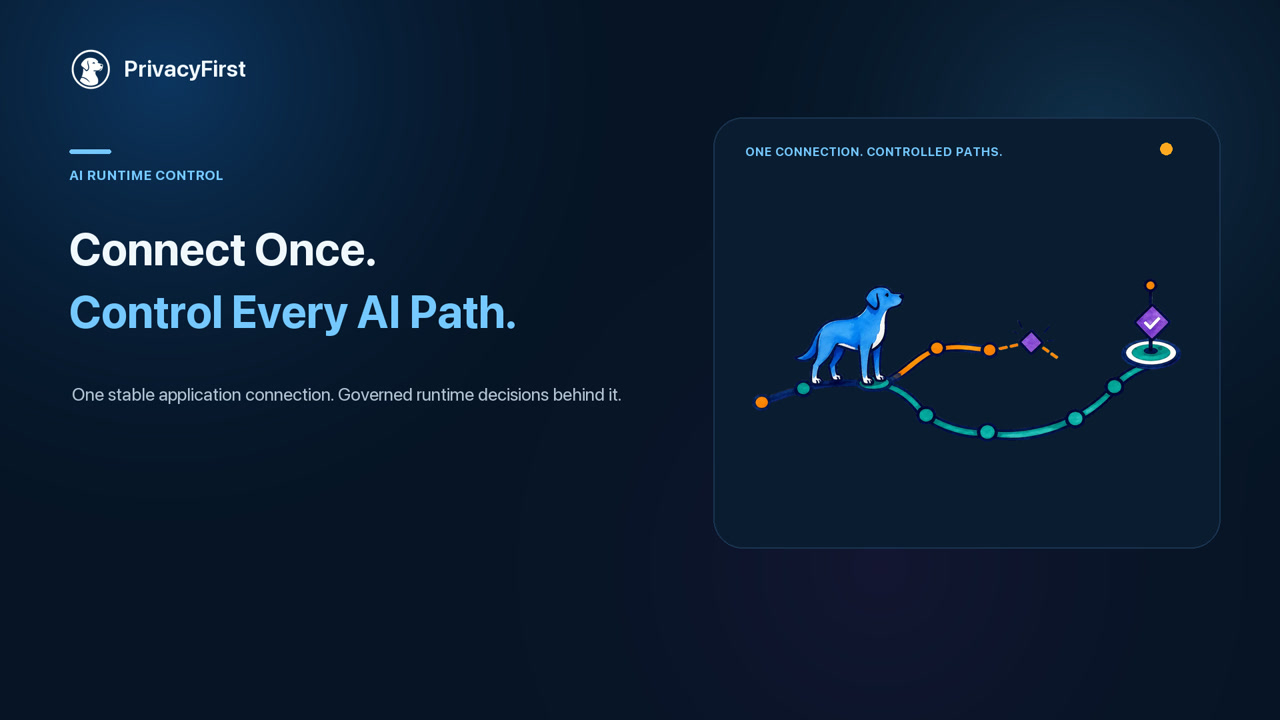
Connect Once. Control Every AI Path.
Move one application to a stable governed connection, then inspect scoped access, limits, approved routing, failover, semantic-cache choices, and multi-model pipelines.
What this answers
- What changes in the application connection?
- Where are provider routes, limits, and fallback choices managed?
- How does the resulting request path remain inspectable?
Transcript
A production A.I. application rarely stays simple. A second provider is added for capacity. Retries move into application code. Each team invents its own limits, fallbacks, and model selection. Soon, changing the runtime means changing every application that uses it. At enterprise scale, that is not flexibility. It is the same control logic duplicated across an estate nobody can change or explain from one place. PrivacyFirst gives the application one governed connection. The platform team creates a scoped production key, then points its existing OpenAI client at the PrivacyFirst base URL. The request shape and business logic stay familiar. The key has its own identity, revoke path, processing configuration, and activity. Provider credentials and routing decisions no longer have to live in the application, and the quickstart never reveals a stored secret. Before traffic grows, the team sets its operating boundary. Workspace limits cover request rate, concurrency, daily and monthly tokens, and estimated monthly model cost. A single key can be tighter than the workspace, so one workload cannot consume capacity reserved for another. Current use and reset windows sit beside the effective limit. If a managed-tier boundary is lower than the configured value, the lower number is what the gateway applies and displays. Now the route becomes a governed object. This priority-failover pool has an approved primary and backup, in a deliberate order. Operators can change the provider, model tier, or order here while the application continues to call the same endpoint. Live health shows the current breaker state and utilization, while the pool makes the intended recovery path explicit. The route is visible before an incident, not reconstructed afterward from retry code spread across services. The control becomes real on one request. The primary target throttled after nineteen hundred milliseconds. PrivacyFirst followed the approved failover path, and the backup succeeded after thirty-nine hundred and twenty-five milliseconds. One provider throttle was absorbed, and the caller still received a successful response. The routing decision stays attached to the request, including target order, elapsed time, and recovery outcome. The same connection can change how repeated work is handled. Semantic caching is enabled per key with an explicit retention disclosure. In this workspace, two hundred and eighty-eight verified hits avoided one hundred and ninety-two thousand, nine hundred and fifty-five provider tokens. The surface also reports estimated model cost and latency avoided. Another key can remain uncached, and the application contract does not change. A higher-risk workflow can use a specialized path behind another scoped key. Triage Guard fans one request across the fast and reasoning pools, then joins their outputs through the balanced pool. A per-request cost ceiling remains visible. PrivacyFirst does not call that an improvement by assumption. The team verifies uplift on its own private benchmark before routing production traffic through the pipeline. One governed connection can now carry distinct, explainable runtime paths without duplicating the control logic in every application. Bring us one production A.I. endpoint. We will show you how to keep the connection stable while providers, limits, failover, caching, and execution paths stay under control. Book a live demo at PrivacyFirst dot A.I.